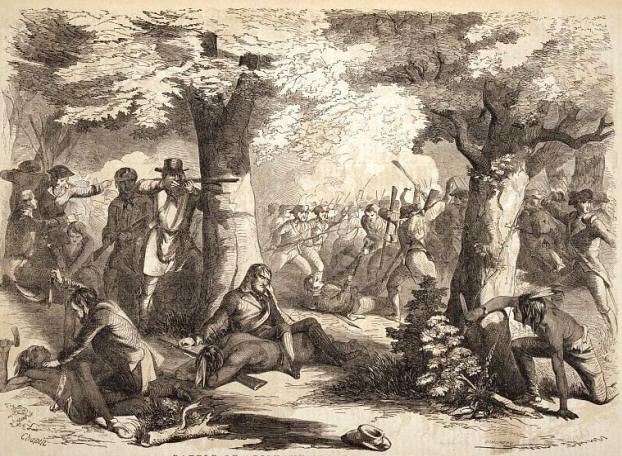
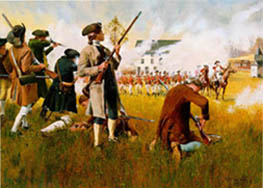
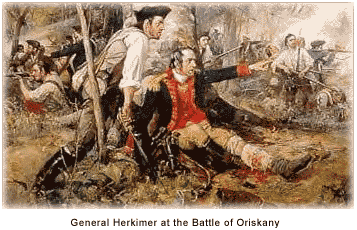
About 4 miles from Saratoga, on the afternoon of the 19th September, a sharp encounter took place between part of the English right wing, under Burgoyne himself, and a strong body of the enemy, under Gates and Arnold.
The conflict lasted till sunset. The British remained masters of the field. But the loss on each side was nearly equal (from 500 to 600 men) and the spirits of the Americans were greatly raised by having withstood the best regular troops of the English army.
Burgoyne now halted again, and strengthened his position by field works and redoubts. And the Americans also improved their defenses. The two armies remained nearly within cannon-shot of each other for a considerable time, during which Burgoyne was anxiously looking for intelligence of the promised expedition from New York, which, according to the original plan, ought by this time to have been approaching Albany from the south.
At last, a messenger from Clinton made his way with great difficulty, to Burgoyne's camp and brought the information that Clinton was on his way up the Hudson to attack the American forts which barred the passage up that river to Albany.
Burgoyne had overestimated his resources and in the very beginning of October found difficulty and distress pressing him hard. The Indians and Canadians began to desert him. While, on the other hand, Gate's army was continually reinforced by fresh bodies of the militia.
An expeditionary force was detached by the Americans, which made a bold, though unsuccessful, attempt to retake Ticonderoga. And finding the number and spirit of the enemy to increase daily, and his own stores of provision to diminish, Burgoyne determined on attacking the Americans in front of him, and by dislodging them from their position, to gain the means of moving upon Albany, or at least of relieving his troops from the straitened position in which they were cooped up.

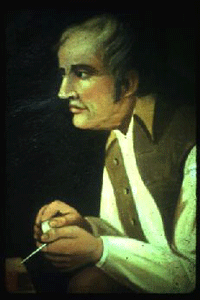
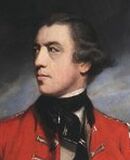 General John Burgoyne (24 February 1722 – 4 August 1792) was a British army officer, politician and dramatist. He first saw action during the Seven Years' War when he participated in several battles, mostly notably during the Portugal Campaign of 1762.
 Casualties (killed and wounded):Staff: 5
 The force Major General Wolfe took onto the Plains of Abraham for the battle was around 4,500 men and 1 gun. The Marquis de Montcalm brought to the battle a force of around 5,000 men and 3 guns.


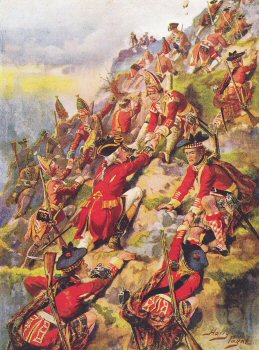 The Battle of Quebec was an attempt on December 31, 1775, by American colonial forces to capture the city of Quebec, drive the British military from the Province of Quebec, and enlist French Canadian support for the American Revolutionary War.